
The Friday–Monday Problem
It’s a scene that plays out in kitchens and living rooms every week. Your child sits down on Thursday evening, runs through their spelling list a few times, and confidently walks into Friday’s test. The result? Full marks. You breathe a sigh of relief — another week done.
Then Monday arrives. Your child writes a paragraph in class, and the teacher’s feedback comes back dotted with corrections. Words your child spelled perfectly just three days ago are now misspelled. Capital letters are missing. Full stops have vanished. It feels like all that practice was for nothing.
If this sounds familiar, you’re not alone. This gap between test results and real writing is so common that there’s a name for it: the Spelling Test Illusion. It doesn’t mean your child isn’t trying hard enough. It means the way most spelling tests work doesn’t match how the brain actually uses spelling in everyday writing.
Why Spelling Falls Apart During Real Writing
To understand why this happens, think about what your child’s brain is doing during a traditional spelling test compared to actual writing.
In a typical word-list test, the child hears one word, focuses entirely on that word, and writes it down. Their brain has one job: remember the correct sequence of letters. There’s no sentence to build, no punctuation to place, and no capital letters to think about. All of their mental energy goes toward a single task.
Now compare that to writing a real sentence. Suddenly, the brain has to juggle many tasks at the same time:
- Spelling — remembering the correct letters for every word in the sentence.
- Capital letters — starting the sentence with a capital, capitalising names and places.
- Punctuation — adding full stops, commas, question marks, and apostrophes in the right places.
- Spacing — leaving clear gaps between each word.
- Meaning — choosing the right word when words sound the same (like there, their, and they’re).
When children are only trained on individual words, the sudden demand of handling all of these tasks at once overwhelms their working memory. Think of it like learning to pat your head and rub your tummy at the same time — each action is easy on its own, but doing both together takes practice. The spelling accuracy that looked rock-solid in isolation crumbles under this heavier workload.
This is the heart of the Spelling Test Illusion. High scores on word-list tests give a misleading picture of a child’s true spelling ability, because the test conditions are far simpler than the conditions of real writing.
The Missing Piece: Practising Spelling in Context
The good news is that there’s a straightforward way to close this gap: practise spelling inside full sentences, not just as isolated words.
When a child practises writing a complete sentence from dictation, their brain learns to manage spelling alongside everything else — capitals, punctuation, spacing, and word choice. Over time, the mental effort needed for each of these tasks decreases. Spelling becomes more automatic, and the child’s brain frees up energy to focus on what they actually want to say.
Educators call this process building fluency. Just like a child learning to ride a bicycle eventually stops thinking about pedalling and starts enjoying the ride, sentence-level practice helps spelling become second nature.
Contextual practice also solves one of the trickiest parts of English spelling: words that sound the same but are spelled differently depending on their meaning. A child practising the word there in isolation has no way to distinguish it from their or they’re. But when they hear and write the sentence “They’re going to play over there with their friends,” the meaning of each word becomes clear, and the correct spelling follows naturally. (Spelling Boost also helps during single-word practice — each word comes with AI-generated definitions and example sentences so your child can see exactly how a word is used in context, even before moving to full sentence dictation.)
What Isolated Word Tests Miss
| Skill | Tested by Word Lists? | Tested by Sentence Dictation? |
|---|---|---|
| Correct letter sequence | ✅ Yes | ✅ Yes |
| Capital letters | ❌ No | ✅ Yes |
| Full stops and commas | ❌ No | ✅ Yes |
| Word spacing | ❌ No | ✅ Yes |
| Choosing the right homophone | ❌ No | ✅ Yes — sentence meaning makes it clear |
| Spelling under realistic conditions | ❌ No — single-task focus | ✅ Yes — multi-task, just like real writing |
This doesn’t mean word lists are useless — they’re a great starting point for learning new vocabulary. But to build the kind of spelling confidence that transfers into real schoolwork, children need to practise in the same way they’ll actually write: in full sentences.
How Spelling Boost Makes Sentence Practice Effortless
We built Text Practice Mode in Spelling Boost to solve exactly this problem. Instead of limiting practice to single words, your child can now practise complete passages — the same paragraphs their teacher sends home for homework — with the app handling all the dictation and marking for you.
Step 1: Scan the Homework in Seconds
No more typing out long passages by hand. Simply point your phone’s camera at the printed homework sheet and the app scans and converts it into a ready-to-use dictation exercise in seconds. The scanner supports both individual word lists and full text passages.
Step 2: The App Dictates, Your Child Writes
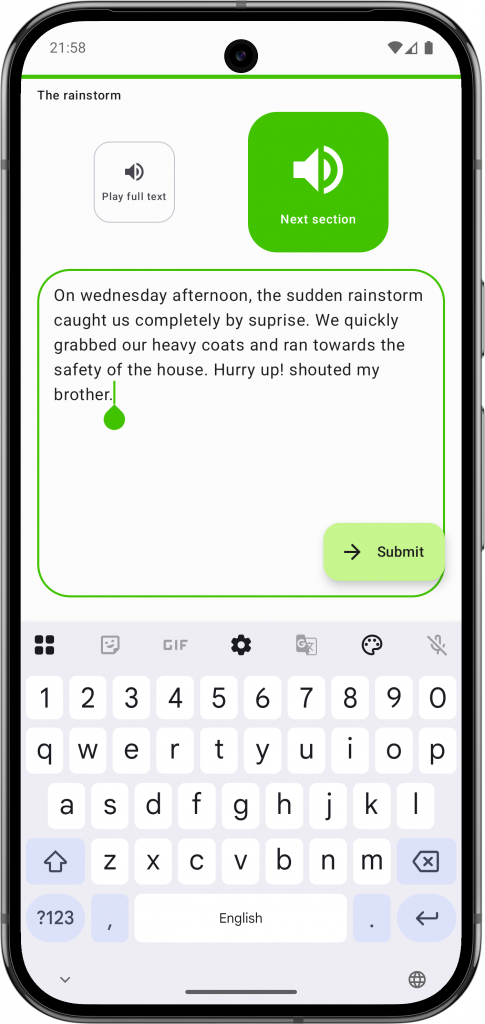
Once scanned, Spelling Boost reads the passage aloud — sentence by sentence — using clear, natural-sounding speech in over 70 languages and regional accents. Your child listens and writes each sentence on the screen using their finger or a stylus. The app checks not just spelling, but also capitalisation, punctuation, and spacing — exactly the skills they need for real classroom writing.
This means your child practises under realistic conditions every single time, building the kind of automatic fluency that isolated word drills simply cannot provide.
Step 3: Friendly, Encouraging Feedback
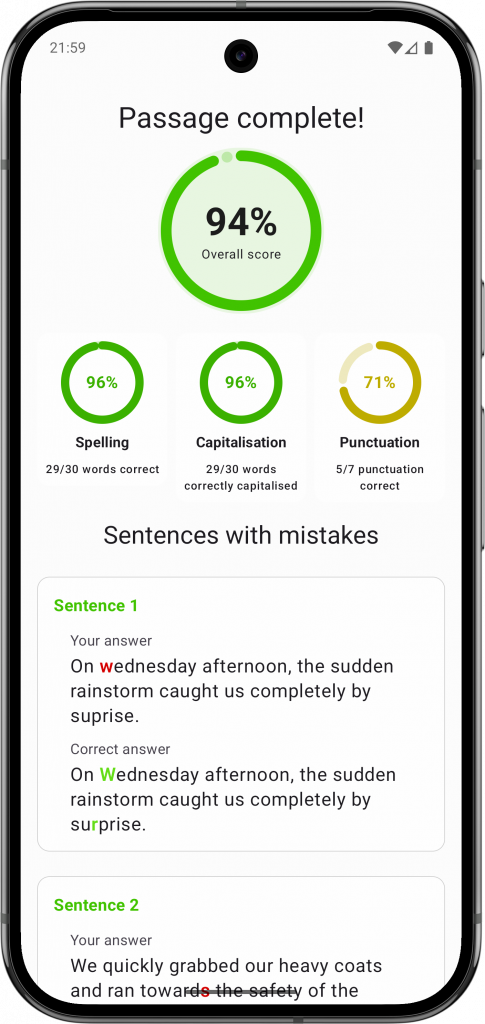
After completing the dictation of the piece of text, the app shows a clear, side-by-side comparison of what your child wrote versus the correct version for each incorrectly written sentence. Instead of a page covered in red ink, mistakes are highlighted gently — making it easy for your child to see exactly where a comma was missed or a letter was swapped, without feeling discouraged.
And when they get everything right? Playful confetti fills the screen to celebrate their success, making every milestone feel like a genuine win.
Step 4: Active Correction That Sticks
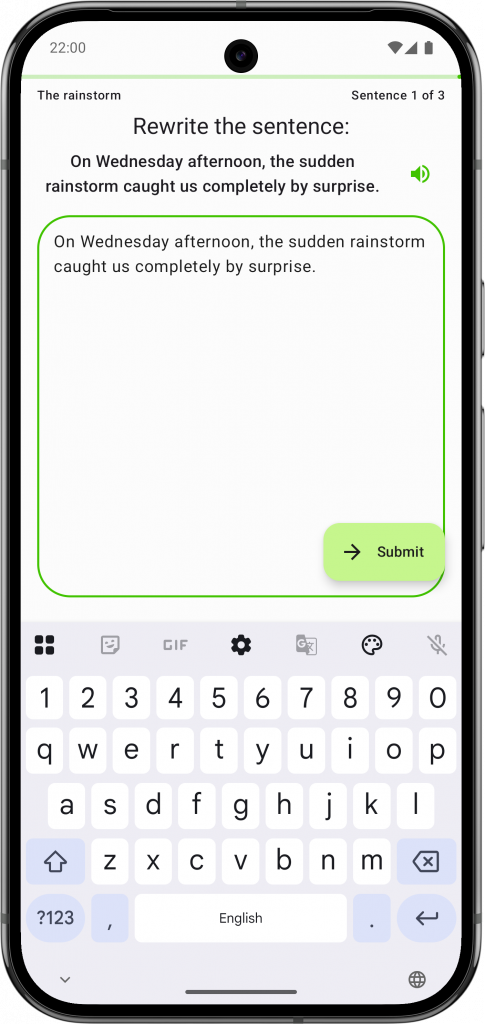
Seeing a mistake is only half the learning. To make the correction truly stick, Spelling Boost asks your child to rewrite the sentence correctly before moving on. This active rewriting step builds the physical muscle memory and mental patterns needed to get it right next time — turning a simple correction into a lasting lesson.
Tricky Words Don’t Slip Through the Cracks
What happens when your child keeps misspelling a particular word? Spelling Boost tracks every attempt automatically. Words that are frequently misspelled are flagged as Tricky Words and added to a focused review queue. The app brings these words back at just the right time, using spaced repetition to build deep, long-term memory — so nothing slips through the cracks.
From Word Lists to Confident Writers
Word lists are a helpful starting point, but they’re only the beginning of the journey. To raise a child who spells confidently in their everyday writing — not just on Friday tests — they need practice that mirrors the real demands of composition.
Here’s a simple routine you can start this week:
- Learn the words first — use your child’s weekly word list to build familiarity with new vocabulary. Our guide to spelling test practice has lots of strategies for this step.
- Practise in sentences — once the words feel comfortable in isolation, switch to Text Practice Mode. Scan a passage from the school homework sheet, or create your own sentences using the target words.
- Review the tricky ones — let Spelling Boost’s Tricky Words system automatically identify and schedule review sessions for the words your child finds hardest.
This progression — from individual words, to sentences, to targeted review — builds the complete set of skills your child needs to write fluently and confidently. And because the app handles the dictation and marking, your child can practise independently while you get on with your evening. Learn more about how Spelling Boost fits into your family routine on our guide for parents.
Ready to move beyond the Spelling Test Illusion and build real writing confidence? Download Spelling Boost free on the Google Play Store and try Text Practice Mode today.
Further Reading
- (Re)thinking the Phonics-Spelling Connection — Research on why spelling mastery from isolated phonics drills often fails to transfer into independent writing (ScholarWorks@GVSU).
- The Impact of Promoting Transcription on Early Text Production — Study showing how building transcription fluency frees up working memory for higher-level composition (ResearchGate).
- Written Language Disorders — Overview of how phonological, orthographic, and morphological systems interact during writing (American Speech-Language-Hearing Association).
- What’s the Difference Between a Dictation and a Spelling Test? — Explains why sentence-level dictation assesses deeper literacy skills than isolated word tests (From Sounds to Spelling).
- How to Practice for a Spelling Test: A Science-Backed Guide — Our own in-depth guide to evidence-based spelling strategies for weekly school tests.